Roger William Corman (born April 5, 1926) is an American film producer and director. Sometimes nicknamed "King of the B-movies" for his output of B-movies (though he himself rejects this as inaccurate), Corman has mostly worked on low-budget films. Some of his work has an established critical reputation, such as his cycle of films derived from the tales of Edgar Allan Poe, and he has also won an Academy Award for his work. Corman is also an occasional actor, taking minor roles in such films as The Silence of the Lambs, The Godfather Part II, Apollo 13 and Philadelphia.
Corman has served as a mentor to many famous directors early in their careers, stressing the importance of budgeting and resourcefulness; Corman once joked he could make a film about the fall of the Roman Empire with two extras and a sagebrush.
Early life
Corman was born in Detroit, Michigan, the son of Anne and William Corman, an engineer. His brother Gene Corman has also produced numerous films, sometimes in collaboration with Roger. Roger Corman received an industrial engineering degree from Stanford University, beginning his film career in 1953 as a producer and screenwriter. Corman started directing films in 1955.
Career
In Corman's most active period, he would produce up to seven movies a year. His fastest film was perhaps The Little Shop of Horrors (1960), which was reputedly shot in two days and one night. Supposedly, he had made a bet that he could shoot an entire feature film in less than three days. Another version of the story claims that he had a set rented for a month, and finished using it with three days to spare, thus pushing him to use the set to make a new film (These claims are disputed by others who worked on the film, who have called it part of Corman's own myth-building). Although highly cost-effective, Corman's parsimonious approach to filmmaking was not without its critics; Charles B. Griffith, who wrote the original screenplay for Little Shop, later remarked that "[Corman] uses half his genius to degrade his own work, and the rest to degrade the artists who work for him."
Corman is probably best known for his filmings of various Edgar Allan Poe stories at American International Pictures, mostly in collaboration with writer/scenarist Richard Matheson, including House of Usher (1960), The Pit and the Pendulum (1961), The Premature Burial (1962), Tales of Terror (1962), The Raven (1963), The Haunted Palace (1963), The Masque of the Red Death (1964), and The Tomb of Ligeia (1964). All but The Premature Burial starred Vincent Price. After the film version of The Raven was completed, he reportedly realized he still had some shooting days left before the sets were torn down and so made another film; The Terror (1963) on the spot with the remaining cast, crew and sets.
The Addams Family is an American television series based on the characters in Charles Addams' New Yorker cartoons. The 30-minute series was shot in black-and-white and aired for two seasons in 64 installments on ABC from September 18, 1964 to April 8, 1966. It is often compared to its working-class rival, The Munsters, which ran for the same two seasons and achieved somewhat higher Nielsen ratings. The Addams Family ranked 23rd in its first season, with a 23.9 rating.[2] The show is the first adaptation of the characters to feature The Addams Family Theme.
It was originally produced by Filmways, Inc. at General Service Studios in Hollywood, California. Successor company MGM Television (via The Program Exchange for broadcast syndication, 20th Century Fox Home Entertainment for home video/DVD) owns the rights to the show. At one point, distribution rights were licensed to Worldvision Enterprises.
Premise
The Addamses are a close-knit extended family with decidedly macabre interests. They are humans with supernatural abilities. No explanation for their powers is explicitly given in the series.
The very wealthy, endlessly enthusiastic Gomez Addams is madly in love with his refined wife Morticia. Along with their two children, Wednesday and Pugsley, Uncle Fester and Grandmama, they reside in an ornate, gloomy, Second Empire style mansion, attended by their servants, Lurch, the towering butler, and Thing, a hand that usually appears out of a small wooden box. Occasionally, episodes would feature relatives or other members of their weird subculture, such as Cousin Itt or Morticia's older sister, Ophelia.
Much of the humor derives from their culture clash with the rest of the world. They invariably treat normal visitors with great warmth and courtesy, even though their guests often have evil intentions. They are puzzled by the horrified reactions to their (to them) good natured and normal behavior since they are under the impression that their tastes are shared by most of society. Accordingly they view "conventional" tastes with generally tolerant suspicion. For example, Fester once cites a neighboring family's meticulously maintained petunia patches as evidence that they are "nothing but riff-raff." Ironically, many of the things that the Addams family was in favor of that seemed laughable in the mid-1960s have become mainsteam. Homeschooling, protection of swamps (now Federally protected as wetlands), banning of toy guns, and banning of classic fairy tales in schools were all plotlines in the show that were comic fodder at the time. A recurring theme in the epilogue of many episodes was the Addamses getting an update on the most recent visitor to their home, either via something in the newspaper or a phone call. Invariably, as a result of their visit to the Addamses, the visitor would be institutionalized, change professions, move out of the country, or have some other negative life-changing event. The Addamses would always misinterpret the update and see it as good news for that most recent visitor.
The tone was set by series producer Nat Perrin, close friend of Groucho Marx and writer of several Marx Brothers films. Perrin created story ideas, directed one episode, and rewrote every script. Much of the dialog is his (albeit uncredited). As a result, Gomez, with his sardonic remarks, backwards logic, and ever-present cigar (pulled from his breast pocket already lit), has been frequently compared to Groucho Marx. In addition, the series often employed the same type of zany satire and screwball humor seen in the Marx Brothers films. It lampooned politics ("Gomez, The Politician" and "Gomez, The People's Choice"), the legal system ("The Addams Family in Court"), Beatlemania ("Lurch, The Teenage Idol"), and Hollywood ("My Fair Cousin Itt").
Characters
Main characters
Gomez Addams (John Astin) - Gomez is passionately in love with his wife, often referring to her as "Cara Mia." His ardor is greatly intensified when she speaks French (a quirk that first appears in the eleventh episode, "The Addams Family Meet the V.I.P.s"). Before that his ardor was aroused when she called him "Bubele" a German-Bavarian, and Yiddish [3][4] word meaning "darling" or "sweetie." Gomez is very wealthy, due to owning numerous companies and stocks. He doesn't seem to regard money itself as a priority and squanders money cavalierly while remaining wealthy. Gomez spends a great deal of time with his family and does not go out to work. He refers to Spain as his "ancestral home" with his family background referenced as "Castilian," and he occasionally uses Spanish words and phrases. He can perform rapid and complicated calculations in his head. He is remarkably acrobatic and can easily dismount from a hanging position upon a chandelier.
Morticia Addams (Carolyn Jones) - Morticia is a cultivated and beautiful woman who dabbles in art, raises flesh-eating plants, and trims her roses by clipping off the buds and arranging the stems in a vase ("Oh, the thorns are lovely this year"). She can light candles with her fingertips and emit smoke directly from her person. With her aristocratic detachment, she is often the calm center of the chaotic events of the household.
Uncle Fester (Jackie Coogan) - Uncle Fester is Morticia's exuberant, kind, and electric uncle. He frequently places a lightbulb in his mouth, where it lights up. When angered by outsiders, he may grab for a blunderbuss and announce that he will shoot the offender in the back.
Lurch (Ted Cassidy) - Lurch is the household butler. Morticia and Gomez summon him by means of a bell pull in the form of a hangman's noose, which rings the massive bell located in the mansion's bell tower; the resulting gong shakes the entire house when the noose is pulled. When Lurch appears (usually immediately thereafter), he responds with a baritone "You rang?" According to IMDb, Lurch was intended to be a non-speaking part, as the Charles Addams cartoon character was silent. However, Cassidy improvised the line during his audition, and it was well received and incorporated into the show. When questions are posed to Lurch his primary response is a deep annoyed grunt, from which the family glean complex meanings. He is superhumanly strong and often plays the harpsichord (the music is actually played by The Addams Family composer Vic Mizzy). Lurch is very high-minded about visitors; when a plainclothes policeman (played by George Neise) visited the family, Lurch patted him down and regarded him suspiciously when he found his gun. Neise showed Lurch his badge, whereupon Lurch returned the gun. Lurch occasionally regards his employers' activities with some dubiousness much like a servant expressing disdain for the idle rich. Ted Cassidy made a cameo appearance as Lurch on an episode of the "Batman" TV series.
Grandmama Addams (Blossom Rock) - Mother of Gomez (who occasionally calls her "Mamacita"). She is a witch who conjures up potions, spells and hexes. She also dabbles in fortune-telling, though it is obvious that, in this respect at least, she is a charlatan. Her given name is never revealed in the series.
Wednesday Friday Addams (Lisa Loring) - Gomez and Morticia's daughter. She is the youngest member (six years old) of the family, she is a strange yet sweet-natured little girl who pursues such hobbies as raising spiders, beheading dolls (called "Marie Antoinette," "Mary Queen of Scots," and "Little Red Riding Hood"), and practicing ballet in a black tutu. Her favorite pet is a black widow spider named Homer, although she also has a lizard named Lucifer. She is strong enough to bring her father to his knees in a judo hold.
Pugsley Addams (Ken Weatherwax) - Gomez and Morticia' son and Wednesday's older brother. Kind-hearted and smart, occasionally conforming to "conventional" standards contrary to his family, he nevertheless shares a close bond with his parents and sister, the latter whom he often plays with. He also enjoys engineering various machines (sometimes with Gomez), playing with blasting caps, and his pet octopus Aristotle. Despite his pudginess, Pugsley is, like his father, exceptionally agile, able to out-climb a gorilla and hang from branches by his teeth.
Thing T. Thing - A disembodied hand that appears out of boxes and other conveniently placed containers. Thing apparently has the ability to teleport from container to container, almost instantly: Thing sometimes appears from different containers at opposite ends of the room within seconds of each other. Though Ted Cassidy would often portray Thing, assistant director Jack Voglin would often portray Thing in scenes where Lurch and Thing appear together.
Recurring characters
Cousin Itt (Felix Silla in most episodes, Roger Arroyo for two episodes) - Gomez's cousin, a short entity completely hidden by his almost head-to-floor-long hair. He speaks in rapid unintelligible gibberish which the family has no difficulty understanding (according to Felix Silla's commentary on the DVD release, the voice for Cousin Itt was recorded by a member of the crew in post-production). Gomez once asks him what is under it all; Itt answers, "Roots." In one episode, Itt is said to have "the eye of an eagle...plus a few of his own." Nevertheless, he wears conventional sunglasses, supposedly so people will not pester him for autographs.
Ophelia - Morticia's sister. Gomez was originally engaged to her in an arranged marriage, but when he saw 22-year old Morticia (dressed in a grown-up version of Wednesday's clothing), he was smitten and fell in love with her; when she spoke French, he claimed that for the first time in his life, his sinuses were cleared and his bronchitis was gone. Ophelia was played by Carolyn Jones in a blonde wig (a staple of 1960's sitcom twins). One quirk of Ophelia's is that the flower growing in her hair had roots that travelled down into her foot; another is her love of judo, with which she can hurl men (usually Gomez) several feet.
Grandma Hester Frump (Margaret Hamilton) - The mother of Morticia and Ophelia.
Mayor Arthur J. Hansen (Peter Baer) - The mayor of the town that the Addams Family live in.
Reunions
A reunion film, Halloween with the New Addams Family [5], aired on NBC in October 1977 and starred most of the original cast, except for Blossom Rock (Grandmama), who was very ill at the time and was replaced by Phyllis actress Jane Rose. The picture also featured extended family members who were created specifically for the production and never appeared in the television series, such as Gomez's brother, Pancho (played by Henry Darrow) and two additional children, Wednesday Junior and Pugsley Junior. It was originally intended for a pilot for a sequel, but no other episodes were ordered.
The interior set of the Addams mansion had previously been used for the 1972 film Ben.
Syndication
As of May 2009, the show can be purchased on iTunes, and can be streamed for free in the US on IMDB, YouTube, Hulu, and Minisodes are available on Crackle You can also watch all the series vol.1-3 on netflix.
DVD releases
MGM Home Entertainment has released The Addams Family on DVD in Region 1, 2 and 4 in three volume sets.
References
1.^ "David Levy; Producer Created 'Addams Family'". LA Times. January 31, 2000. 2.^ "The 'Addams Family' Tree". LA Times. June 9, 1991. 3.^ Yiddish Expressions 4.^ Reminiscing 'Bout Bubba and others 5.^ IMDb.com – Halloween with the New Addams Family 6.^ The Addams Family DVD news: Volume 3 date and details | TVShowsOnDVD.com 7.^ The Addams Family DVD news: *Snap* *Snap* Complete Series Announced | TVShowsOnDVD.com
Dorothy Stratten (February 28, 1960 – August 14, 1980)[1] was a Canadian model and actress. Stratten found fame as the Playboy Playmate of the Month for August 1979 and subsequently Playmate of the Year for 1980.[1] She was the second Playmate (after Lee Ann Michelle) to be born in the 1960s. Stratten is most remembered for the circumstances of her murder at age 20 by her estranged husband/manager, Paul Snider, who committed suicide later the same day. The circumstances surrounding her death have inspired two motion pictures.[2]
Life and career
Stratten was born Dorothy Ruth Hoogstraten in a Salvation Army hospital in Vancouver, British Columbia, to Simon and Nelly Hoogstraten, Dutch immigrants.[3] In 1961, her brother John Arthur was born, and her sister Louise Stratten followed in May 1968.
She attended Centennial High School in Coquitlam. In 1977, while working part-time in a local Dairy Queen, she met a Vancouver-area promoter and pimp[3] named Paul Snider (then 26), who had nude photos taken of her and eventually sent them to Playboy. Because she was underage, she had to obtain her mother's signature to have the photos taken.[3]
In 1979, after having her surname shortened to Stratten,[3] she became Playboy's Miss August, and found work as a Bunny at the Los Angeles Playboy Club. She also played the role of Miss Cosmos in the Buck Rogers television series.
In June 1979, she married Snider in Las Vegas, Nevada. The couple's relationship quickly deteriorated, as Snider became prone to fits of jealousy and controlling behavior; he forbade her to drink coffee out of fear that it would damage her teeth, and Stratten believed that he was responsible for the death of her pet dog because he was jealous of the attention she gave it. [4]
In 1980, she became Playboy's Playmate of the Year. Her original pictorial was photographed by Mario Casilli.
Hugh Hefner reportedly encouraged Stratten to sever ties with Snider, calling him a "hustler and a pimp".[3] Rosanne Katon and other friends warned Stratten about Snider's behavior. By August 1980, Snider's grandiosity gave way to obsessive jealousy as he lost control of Stratten's "rocket to the moon".[3] Around this time Stratten began an affair with the director of her first major film, Peter Bogdanovich.[3] Snider hired a private detective to follow Stratten and report back to him everything she did. Snider and Stratten separated, and Stratten moved in with Bogdanovich, planning to file for a divorce from Snider.
Murder
Just after noon on August 14, 1980, Snider and Stratten met at Snider's house, where the two had once lived as a couple and which Snider was then sharing with their mutual friend, Dr. Stephen Cushner, and two women. The two had met to discuss terms for an amicable divorce, and Stratten had brought along $1,000 in the hopes that Snider would accept it as a settlement. [3][4] Around 12:30 pm, the private investigator whom Snider had hired phoned the apartment to see how the meeting was going; Snider answered the phone and told him that "everything is going fine." [4]
Around 5:00 pm, the female occupants of the apartment returned home from work. Finding Snider and Stratten's cars in the driveway and Snider's room door closed, they presumed that the couple wanted privacy. The female occupants watched the six o'clock news and then left to get dinner; at 7:00 pm, Cushner returned home from work, and, also finding Stratten's car in the driveway and Snider's door closed, decided not to disturb the couple. At 8:00 pm, the female occupants returned home and informed Cushner that they hadn't checked on Stratten and Snider either.[4]
At 11:00 pm, Cushner received a phone call on his private line from Snider's private investigator, who told him that he had been attempting to contact Snider for several hours but that Snider would not answer his phone. At the investigator's request, Cushner forced his way into Snider's room and found the couple; both were dead, completely nude and being partily eaten by ants. [4][3][5] Stratten was on the bed, dead from a shotgun blast that had taken off the side of her face and her left index finger. Evidence collected at the scene by police speculated that between 12:30 and 1:00 pm that Snider may have sexually forced himself on Stratten during an argument which turned violent in which he may have forcibily tied her up and then raped and sodomized before killing her with a shotgun that he kept in his room. Evidence also indicated that after having murdered Stratten, Snider had used medical tape to secure her corpse to a bondage bench and engaged in necrophilia with it before laying her corpse on the bed. Snider then turned the shotgun on himself.
Dorothy Stratten is buried at Westwood Memorial Park in Los Angeles, California. Stratten and Carol Willis are the only two Playmates to die within a year and a half of their Playboy appearances. At 20 and 22 years of age respectively, they were also the youngest.
In popular culture
Jamie Lee Curtis portrayed Stratten and Bruce Weitz played Paul Snider in the 1981 television film Death of a Centerfold: The Dorothy Stratten Story.
Stratten's story was portrayed in Bob Fosse's 1983 film Star 80 starring Mariel Hemingway[2] (Stratten) and Eric Roberts (Snider). The movie was filmed in the very same house and room where the actual murder/suicide occurred.
Peter Bogdanovich wrote a book about Stratten titled The Killing of the Unicorn, published in the summer of 1984. Four years later, at the age of 49, he married Stratten's sister, Louise, age 20. Earlier, Bogdanovich had paid for Louise's private school and modeling classes after Stratten's death.[6] They divorced in 2001 after 13 years of marriage.
Bryan Adams co-wrote two songs about Stratten. The first, "Cover Girl," became a hit for the band Prism in 1980. The second, "The Best Was Yet to Come," was written with Jim Vallance; it appeared on Adams' 1983 album Cuts Like a Knife and was later covered by Laura Branigan.
References
Notes
1.^ "Playmate data". http://wekinglypigs.com/cgi-bin/nand/search/pmstat?browse=%3A%3ACONFIG%3A%3Amodelbrowse&key=stratten%2C+dorothy&limit=0. Retrieved January 29, 2010. 2.^ Vincent Canby (1983-11-10). "SCREEN: 'STAR 80,' A SEX-SYMBOL'S LIFE AND DEATH". The New York Times. http://query.nytimes.com/gst/fullpage.html?res=9F00E1DD1539F933A25752C1A965948260&sec=&spon=&pagewanted=all. Retrieved 2008-07-22. 3.^ Theresa Carpenter (1980-11-05). "Death of a Playmate". The Village Voice. http://books.google.com/books?id=W2x4AjHQdWMC&pg=PA35&dq=dorothy+stratten+%22death+of+a+playmate%22+carpenter&client=opera&sig=ACfU3U2SgFMikHVULMokuL5PTJxbLi_QOw. Retrieved 2008-07-22. 4.^ The Murder of Dorothy Stratten 5.^ Biskind, Peter (1998). Easy Riders Raging Bulls: How the Sex-Drugs-and Rock 'N Roll Generation Saved Hollywood. Simon & Schuster. pp. 388, 389. ISBN 0-684-80996-6. 6.^ The Centerfold Murder
Further reading
Yule, Andrew. Picture Shows: the Life and Films of Peter Bogdanovich - Has extensive coverage of Stratten's relationships with Paul Snider and Peter Bogdonovich.
Sharon Marie Tate (January 24, 1943 – August 9, 1969) was an American actress. During the 1960s she played small television roles before appearing in several films. After receiving positive reviews for her comedic performances, she was hailed as one of Hollywood's promising newcomers and was nominated for a Golden Globe Award for her performance in Valley of the Dolls (1967). She also appeared regularly in fashion magazines as a model and cover girl.
Married to the film director Roman Polanski in 1968, Tate was eight and a half months pregnant when she was murdered in her home, along with four others, by followers of Charles Manson.
In the first days of November 1968, Charles Manson established The Family at alternative headquarters in Death Valley's environs, where they occupied two unused or little-used ranches, Myers and Barker. The former, to which the group had initially headed, was owned by the grandmother of a new woman in the Family. The latter was owned by an elderly, local woman to whom Manson presented himself and a male Family member as musicians in need of a place congenial to their work. When the woman agreed to let them stay there if they'd fix up things, Manson honored her with one of the Beach Boys' gold records, several of which he had been given by Dennis Wilson.
While back at Spahn Ranch, no later than December, Manson and Tex Watson visited a Topanga Canyon acquaintance who played them the Beatles' White Album, then recently released. Despite having been 29 years old and imprisoned when the Beatles first came to America in 1964, Manson was obsessed with the group. At McNeil Prison, he had told fellow inmates, including Alvin Karpis, that he could surpass the group in fame; to the Family, he spoke of the group as "the soul" and "part of 'the hole in the infinite.'"
For some time, Manson had been saying that racial tension between blacks and whites was growing and that blacks would soon rise up in rebellion in America's cities. He had emphasized Martin Luther King, Jr.'s assassination, which had taken place on April 4, 1968. On a bitterly cold New Year's Eve at Myers Ranch, the Family members, gathered outside around a large fire, listened as Manson explained that the social turmoil he had been predicting had also been predicted by the Beatles. The White Album songs, he declared, told it all, although in code. In fact, he maintained (or would soon maintain), the album was directed at the Family itself, an elect group that was being instructed to preserve the worthy from the impending disaster.
In early January 1969, the Family escaped the desert's cold and positioned itself to monitor L.A.'s supposed tension by moving to a canary-yellow home in Canoga Park, not far from the Spahn Ranch. Because this locale would allow the group to remain "submerged beneath the awareness of the outside world," Manson called it the Yellow Submarine, another Beatles reference. There, Family members prepared for the impending apocalypse, which, around the campfire, Manson had termed "Helter Skelter," after the song of that name.
By February, Manson's vision was complete. The Family would create an album whose songs, as subtle as those of the Beatles, would trigger the predicted chaos. Ghastly murders of whites by blacks would be met with retaliation, and a split between racist and non-racist whites would yield whites' self-annihilation. Blacks' triumph, as it were, would merely precede their being ruled by the Family, which would ride out the conflict in "the bottomless pit"—a secret city beneath Death Valley. At the Canoga Park house, while Family members worked on vehicles and pored over maps to prepare for their desert escape, they also worked on songs for their world-changing album. When they were told Terry Melcher was to come to the house to hear the material, the women prepared a meal and cleaned the place; but Melcher never arrived.
Manson's Encounter with Tate
On March 23, 1969, Manson entered, uninvited, upon 10050 Cielo Drive, which he had known as the residence of Terry Melcher. This was Rudi Altobelli's property, where Melcher was no longer the tenant. As of that February, the tenants were Sharon Tate and Roman Polanski.
Manson was met by Shahrokh Hatami, a photographer and Tate's friend. Hatami was there to photograph Tate in advance of her departure for Rome the next day. Having seen Manson through a window as Manson approached the main house, Hatami had gone onto the front porch to ask him what he wanted.
When Manson told Hatami he was looking for someone whose name Hatami did not recognize, Hatami informed him the place was the Polanski residence. Hatami advised him to try "the back alley," by which he meant the path to the guest house, beyond the main house. Concerned over the stranger on the property, Hatami was now down on the front walk, to confront Manson. Appearing behind Hatami, in the house's front door, Tate asked him who was calling. Hatami said a man was looking for someone. Hatami and Tate maintained their positions while Manson, without a word, went back to the guest house, returned a minute or two later, and left.
That evening, Manson returned to the property and again went back to the guest house. Presuming to enter the enclosed porch, he spoke with Rudi Altobelli, who was just coming out of the shower. Although Manson asked for Melcher, Altobelli felt Manson had come looking for him. This is consistent with prosecutor Vincent Bugliosi's later discovery that Manson had apparently been to the place on earlier occasions since Melcher's departure from it.
Speaking through the inner screen door, Altobelli told Manson that Melcher had moved to Malibu. He lied that he did not know Melcher's new address. In response to a question from Manson, Altobelli said he himself was in the entertainment business, although, having met Manson the previous year, at Dennis Wilson's home, he was sure Manson already knew that. At Wilson's, Altobelli had complimented Manson lukewarmly on some of his musical recordings that Wilson had been playing.
When Altobelli informed Manson he was going out of the country the next day, Manson said he'd like to speak with him upon his return; Altobelli lied that he would be gone for more than a year. In response to a direct question from Altobelli, Manson explained that he had been directed to the guest house by the persons in the main house; Altobelli expressed the wish that Manson not disturb his tenants.
Manson left. As Altobelli flew with Tate to Rome the next day, Tate asked him whether "that creepy-looking guy" had gone back to the guest house the day before.
Family crimes
Crowe shooting
On May 18, 1969, Terry Melcher visited Spahn Ranch to hear Manson and the women sing. Melcher arranged a subsequent visit, not long thereafter, on which he brought a friend who possessed a mobile recording unit; but he himself did not record the group.
By June, Manson was telling the Family they might have to show blacks how to start "Helter Skelter." When Manson tasked Watson with obtaining money supposedly intended to help the Family prepare for the conflict, Watson defrauded a black drug dealer named Bernard "Lotsapoppa" Crowe. Crowe responded with a threat to wipe out everyone at Spahn Ranch. Manson countered on July 1, 1969, by shooting Crowe at his Hollywood apartment.
Manson's mistaken belief that he had killed Crowe was seemingly confirmed by a news report of the discovery of the dumped body of a Black Panther in Los Angeles. Although Crowe was not a member of the Black Panthers, Manson, concluding he had been, expected retaliation from the group. He turned Spahn Ranch into a defensive camp, with night patrols of armed guards."If we'd needed any more proof that Helter Skelter was coming down very soon, this was it," Tex Watson would later write, "[B]lackie was trying to get at the chosen ones."
Hinman murder
On July 25, 1969, Manson sent sometime Family member Bobby Beausoleil along with Mary Brunner and Susan Atkins to the house of acquaintance Gary Hinman, to persuade him to turn over money Manson thought Hinman had inherited. The three held the uncooperative Hinman hostage for two days, during which Manson showed up with a sword to slash his ear. After that, Beausoleil stabbed Hinman to death, ostensibly on Manson’s instruction. Before leaving the Topanga Canyon residence, Beausoleil, or one of the women, used Hinman’s blood to write "Political piggy" on the wall and to draw a panther paw, a Black Panther symbol.
In magazine interviews of 1981 and 1998–99, Beausoleil would say he went to Hinman’s to recover money paid to Hinman for drugs that had supposedly been bad; he added that Brunner and Atkins, unaware of his intent, went along idly, merely to visit Hinman. On the other hand, Atkins, in her 1977 autobiography, wrote that Manson directly told Beausoleil, Brunner, and her to go to Hinman’s and get the supposed inheritance—$21,000. She said Manson had told her privately, two days earlier, that, if she wanted to "do something important," she could kill Hinman and get his money.
Tate murders
Beausoleil was arrested on August 6, 1969, after he had been caught driving Hinman's car. Police found the murder weapon in the tire well. Two days later, Manson told Family members at Spahn Ranch, "Now is the time for Helter Skelter."
On the night of August 8, Manson directed Tex Watson to take Susan Atkins, Linda Kasabian, and Patricia Krenwinkel to "that house where Melcher used to live" and "totally destroy everyone in [it], as gruesome as you can." He told the women to do as Watson would instruct them. Krenwinkel was one of the early Family members, one of the hitchhikers who had allegedly been picked up by Dennis Wilson.
On the evening of August 8, 1969, Sharon Tate, Jay Sebring, Wojciech Frykowski and Frykowski's girlfriend, coffee heiress Abigail Folger, ate their last meal at El Coyote on Beverly Boulevard. They returned to the Cielo Drive home in Benedict Canyon about 10:30 p.m.
When the four Family members arrived at the entrance to the Cielo Drive property, Watson climbed a telephone pole near the gate and cut the phone line. He had been to the house previously, on Family matters.
It was now around midnight and into August 9, 1969. Backing their car down to the bottom of the hill that led up to the place, the group parked there and walked back up to the house. Thinking the gate might be electrified or rigged with an alarm, they climbed a brushy embankment at its right and dropped onto the grounds. Just then, headlights came their way from farther within the angled property. Telling the women to lie in the bushes, Watson stepped out, gave a command to halt, and shot to death the approaching driver, 18-year-old Steven Parent. After cutting the screen of an open window of the main house, Watson told Kasabian to keep watch down by the gate. He removed the screen, entered through the window, and let Atkins and Krenwinkel in through the front door.
Slaughter
As Watson whispered to Atkins, Polanski's friend Wojciech Frykowski awoke on the living-room couch; Watson kicked him in the head. When Frykowski asked him who he was and what he was doing there, Watson replied, "I’m the devil, and I’m here to do the devil’s business."
On Watson’s direction, Atkins found the house's three other occupants and, with Krenwinkel's help, brought them to the living room. The three were Tate, eight and a half months pregnant; her friend and former lover Jay Sebring, a noted hairstylist; and Frykowski’s lover Abigail Folger, heiress to the Folger coffee fortune. Polanski, Tate's husband, was in London, at work on a film project.
Watson began to tie Tate and Sebring together by their necks with rope he'd brought and slung up over a beam. Sebring's protest—his second—of rough treatment of Tate prompted Watson to shoot him. Folger was taken momentarily back to her bedroom for her purse, out of which she gave the intruders $70. After that, Watson stabbed the groaning Sebring seven times.
Frykowski's hands had been bound with a towel. Freeing himself, Frykowski began struggling with Atkins, who stabbed at his legs with the knife with which she had been guarding him. As he fought his way toward and out the front door, onto the porch, Watson joined in against him. Watson struck him over the head with the gun multiple times, stabbed him repeatedly, and shot him twice. Watson broke the gun's right grip in the process.
Around this time, Kasabian was drawn up from the driveway by "horrifying sounds." She arrived outside the door. In a vain effort to halt the massacre, she told Atkins falsely that someone was coming.
Inside the house, Folger had escaped from Krenwinkel and fled out a bedroom door to the pool area. Folger was pursued to the front lawn by Krenwinkel, who stabbed – and finally, tackled – her. She was dispatched by Watson; her two assailants had stabbed her twenty-eight times. As Frykowski struggled across the lawn, Watson finished him with a final flurry of stabbing. Frykowski was stabbed a total of fifty-one times.
Back in the house, Atkins, Watson, or both killed Tate, who was stabbed sixteen times. Tate pleaded to be allowed to live long enough to have her baby; she cried, "Mother... mother..." until she was dead.
Earlier, as the four Family members had headed out from Spahn Ranch, Manson had told the women to "leave a sign… something witchy." Using the towel that had bound Frykowski’s hands, Atkins wrote "pig" on the house’s front door, in Tate's blood. En route home, the killers changed out of bloody clothes, which were ditched in the hills, along with their weapons.
In initial confessions to cellmates of hers at Sybil Brand Institute, Atkins would say she killed Tate. In later statements to her attorney, to prosecutor Vincent Bugliosi, and before a grand jury, Atkins indicated Tate had been stabbed by Tex Watson. In his 1978 autobiography, Watson himself said that he stabbed Tate and that Atkins did not. Since he was aware that the prosecutor, Bugliosi, and the jury that had tried the other Tate-LaBianca defendants were convinced Atkins had stabbed Tate, he falsely testified that he did not stab her.
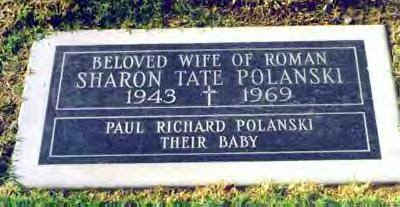
The funerals for the five victims were held on Wednesday, August 13. Sharon Tate was interred in the Holy Cross Cemetery, Culver City, California, with her son, Paul Richard Polanski (named posthumously for Polanski's and Tate's fathers), in her arms. The funerals of Tate and Sebring were separated by several hours to allow mourners to attend both.
A decade after the murders, Tate's mother, Doris, in response to the growing cult status of the killers and the possibility that any of them might be granted parole, organized a public campaign against what she considered shortcomings in the state's corrections system which led to amendments to the California criminal law in 1982, which allowed crime victims and their families to make victim impact statements during sentencing and at parole hearings. Doris Tate was the first person to make such an impact statement under the new law, when she spoke at the parole hearing of one of her daughter's killers, Charles "Tex" Watson. She later said that she believed the changes in the law had afforded her daughter dignity that had been denied her before, and that she had been able to "help transform Sharon's legacy from murder victim to a symbol of victims' rights."
Friedrich "Fritz" Christian Anton Lang (December 5, 1890 – August 2, 1976) was an Austrian-American filmmaker, screenwriter, and occasional film producer and actor. One of the best known émigrés from Germany's school of Expressionism, he was dubbed the "Master of Darkness" by the British Film Institute.[1] His most famous films are the groundbreaking Metropolis (the world's most expensive silent film at the time of its release) and M, made before he moved to the United States, his iconic contribution to the film noir genre.
Life and career
Early life
Lang was born in Vienna as the second son of Anton Lang (1860–1940)[2], an architect and construction company manager, and his wife Pauline "Paula" Lang née Schlesinger (1864–1920). Fritz Lang himself was baptized on 28 December 1890 at the Schottenkirche in Vienna.[3]
Lang's parents were of Moravian descent and practicing Roman Catholics, his mother having been born Jewish and converted to Catholicism when Fritz was ten. His mother took this conversion seriously and was dedicated to raising Fritz as a Catholic. Lang never had an interest in his Jewish heritage and identified himself as Catholic. Although he was not a particularly devout Catholic, he "regularly used Catholic images and themes in[] his films."[4]
After finishing school, Lang briefly attended the Technical University of Vienna, where he studied civil engineering and eventually switched to art. In 1910 he left Vienna to see the world, traveling throughout Europe and Africa and later Asia and the Pacific area. In 1913, he studied painting in Paris, France.
At the outbreak of the First World War, Lang returned to Vienna and volunteer for military service in the Austrian army. He fought in Russia and Romania during World War I, where he was wounded three times. While recovering from his injuries and shell shock in 1916, he wrote some scenarios and ideas for films. He was discharged from the army with the rank of lieutenant in 1918 and did some acting in the Viennese theater circuit for a short time before being hired as a writer at Decla, Erich Pommer's Berlin-based production company.
Expressionist films: the Weimar years (1918-1933)
His writing stint was brief, as Lang soon started to work as a director at the German film studio Ufa, and later Nero-Film, just as the Expressionist movement was building. In this first phase of his career, Lang alternated between art films such as Der Müde Tod ("The Weary Death") and populist thrillers such as Die Spinnen ("The Spiders"), combining popular genres with Expressionist techniques to create an unprecedented synthesis of popular entertainment with art cinema. In 1920, he met his future wife, the writer and actress Thea von Harbou. She and Lang co-wrote all of his movies from 1921 through 1933, including 1922's Dr. Mabuse, der Spieler (Dr. Mabuse the Gambler), which ran for over four hours in two parts in the original version and was the first in the Dr. Mabuse trilogy, 1924's Die Nibelungen, the famed 1927 masterpiece Metropolis, and the 1931 classic, M, his first "talking" picture.
Although some consider Lang's work to be simple melodrama, he produced a coherent oeuvre that helped to establish the characteristics of film noir, with its recurring themes of psychological conflict, paranoia, fate and moral ambiguity. His work influenced filmmakers as disparate as Jacques Rivette and William Friedkin.
In 1931, after Woman in the Moon, Lang directed what many film scholars consider to be his masterpiece: M, a disturbing story of a child murderer (Peter Lorre in his first starring role) who is hunted down and brought to rough justice by Berlin's criminal underworld. M remains a powerful work; it was remade in 1951 by Joseph Losey, but this version had little impact on audiences, and has become harder to see than the original film. Lang epitomized the stereotype of the tyrannical German film director such as Erich von Stroheim and Otto Preminger; he was known for being hard to work with. During the climactic final scene in M, he allegedly threw Peter Lorre down a flight of stairs in order to give more authenticity to Lorre's battered look. His wearing a monocle that added to the stereotype.
At the end of 1932. Lang started filming The Testament of Dr. Mabuse. Adolf Hitler came to power in January 1933, and by March 30, the new regime banned it as an incitement to public disorder. Testament is sometimes deemed an anti-Nazi film as Lang had put phrases used by the Nazis into the mouth of the title character.
Whereas Lang was worried about the advent of the Nazi regime, partly because of his Jewish heritage,[4] his wife and screen writer Thea von Harbou had started to sympathize with the Nazis in the early 1930s and joined the NSDAP in 1932. They soon divorced. Lang's fears would be realized following his departure from Austria, as under Nazi eugenics laws he would be identified as a Jew even though his mother was a converted Roman Catholic, and he was raised as such.
Emigration
Shortly afterwards, Lang left Germany but the circumstances of his emigration remain controversial: According to Lang, propaganda minister Joseph Goebbels called Lang to his offices to inform him that The Testament of Dr Mabuse was being banned but that he was nevertheless so impressed by Lang's abilities as a filmmaker (especially Metropolis), he was offering Lang a position as the head of German film studio UFA. Lang had been, unbeknownst to Goebbels, already planning to leave Germany for Paris, but the meeting with Goebbels ran so long that the banks were closed by the time it finished, and Lang fled that night without his money, not to return until after the war.[5][6]
This account is problematic as many portions cannot be verified, while those that can, run counter to other evidence: Lang actually left Germany with most of his money, unlike most refugees, and made several return trips later in the same year. There were no witnesses to the meeting besides Goebbels and Lang, but Goebbels's appointment books, when they refer to the meeting, mention only the banning of Testament. No evidence has been discovered in any of Goebbels's writings to affirm the suggestion that he was planning to offer Lang any position. Jean-Luc Godard's film Contempt (1963), in which Lang appeared as himself, presents a bare outline of the story as fact.
Whatever the details, Lang did in fact leave Germany in 1934 and moved to Paris.[7] after his marriage to Thea von Harbou, who stayed behind, ended in 1933.
In Paris, Lang filmed a version of Ferenc Molnár's Liliom, starring Charles Boyer. This was Lang's only film in French (not counting the French version of Testament). He then went to the United States.[7]
Hollywood career (1936-1957)
Lang joined the MGM studio and directed the crime drama Fury. He became a naturalized citizen of the United States in 1939. Lang made twenty-one features in the next twenty-one years, working in a variety of genres at every major studio in Hollywood, occasionally producing his films as an independent. These films, often compared unfavourably by contemporary critics to Lang's earlier works, have since been reevaluated as being integral to the emergence and evolution of American genre cinema, film noir in particular.
One of his most famous film noirs is the police drama The Big Heat (1953), noted for its uncompromising brutality, especially for a scene in which Lee Marvin throws scalding coffee on Gloria Grahame's face. During this period, his visual style simplified (owing in part to the constraints of the Hollywood studio system) and his worldview became increasingly pessimistic, culminating in the cold, geometric style of his last American films, While the City Sleeps (1956) and Beyond a Reasonable Doubt (1957).
Lang found it harder to find congenial production conditions in Hollywood and his advancing age left him less inclined to grapple with American backers. The German producer, Artur Brauner, was expressing interest in remaking The Indian Tomb (a story that Lang had developed in the twenties that was ultimately taken from him by studio heads and directed instead by Joe May),[8] so Lang abandoned his plans for retirement and returned to Germany in order to make his "Indian Epic". Following the production, Brauner was ready to proceed with his remake of Das Testament des Doctor Mabuse when Lang approached him with the idea of adding another original film to the series. The result was The Thousand Eyes of Dr. Mabuse (1960), made in a hurry and with a relatively small budget. It can be viewed as the marriage between the director's early experiences with expressionist techniques in Germany as well as the spartan style already visible in his late American work. Lang was approaching blindness during the production, making it his final project.
Death and legacy
While his career had ended without fanfare, his American and later German works were championed by the critics of the Cahiers du cinéma. Lang died in 1976 and was interred in the Forest Lawn - Hollywood Hills Cemetery in Los Angeles.[9]
Pop culture
Lang appears as himself in Jean-Luc Godard's 1963 film Le Mepris. A fictional Lang appears as a main character in the Fullmetal Alchemist movie "Conqueror Of Shambala."
References
1.^ "Fritz Lang: Master of Darkness". British Film Institute. http://www.bfi.org.uk/features/lang/. Retrieved 2009-01-22. 2.^ "Architekturzentrum Wien". Architektenlexikon.at. http://www.architektenlexikon.at/de/345.htm. Retrieved 2010-03-06. 3.^ Vienna, Schottenpfarre, baptismal register Tom. 1890, fol. 83. 4.^ "The religion of director Fritz Lang". http://www.adherents.com/people/pl/Fritz_Lang.html. Retrieved 2009-01-22. 5.^ Michel Ciment: Fritz lang, Le meurtre et la loi, Ed. Gallimard, Collection Découvertes, 04/11/2003. The autor think that this meeting has, in fact, never happened. 6.^ Havis, Allan (2008), Cult Films: Taboo and Transgression, University Press of America, Inc., page 10 7.^ David Kalat, DVD Commentary for The Testament of Dr. Mabuse. New York City, United States: The Criterion Collection (2004) 8.^ Plass, Ulrich (Winter 2009). "Dialectic of Regression: Theador W Adorno and Fritz Lang". Telos 149: 131. 9.^ "Fritz Lang, Film Director Noted for 'M,' Dead at 85". New York Times. August 3, 1976. http://select.nytimes.com/gst/abstract.html?res=FA0617FF3F5A167493C1A91783D85F428785F9. Retrieved 2009-01-22. "Friz Lang, the Viennese-born film director best known for "M", a terrifying study of a child killer, and for other tales of suspense, died yesterday in Los Angeles at the age of 85. He had been ill for some time, and had been inactive professionally for a decade."
Further reading
Friedrich, Otto. City of Nets: A Portrait of Hollywood in the 1940s; New York: Harper & Row, 1986; ISBN 0060156260 (See e.g. pp. 45–46 for anecdotes revealing Lang's arrogance.) McGilligan, Patrick. Fritz Lang: The Nature of the Beast; New York: St. Martins Press, 1997; ISBN 0312132476 Schnauber, Cornelius. Fritz Lang in Hollywood; Wien: Europaverlag, c1986; ISBN 3203509539 (in German) Youngkin, Stephen (2005). The Lost One: A Life of Peter Lorre. University Press of Kentucky. ISBN 0813123607. - Contains interviews with Lang and a discussion of the making of the film M.










![M (The Criterion Collection) [Blu-ray]](https://lh3.googleusercontent.com/blogger_img_proxy/AEn0k_vYzcrzacr3UJT3qB0tQRr1QFv6Zo0mKo_LrR-UVbgs_li1gLwaEIyPeBH9E-MOFYVj_z2b7ciwCFzOwsuq3JQpoWCC0sp04C6wpzNrY_2UdkUz4lVlD3TiKOKoU3CffWyYdKF9jaUdzxY40dMtjwA4cY-b254-2cZZiK2mCVKBJkf3eXWefQhs7QKZhgyj6N6zradvt4YbwrU8jphFKUAfhxIRCgRAnJNWVhKy=s0-d)


