

Showing posts with label cemeteries. Show all posts
Showing posts with label cemeteries. Show all posts
Saturday, January 1, 2011


Saturday, December 25, 2010


Monday, August 16, 2010
Deathday: Bela Lugosi 1882-1956 Hungarian Actor "Dracula"

Béla Lugosi (20 October 1882 – 16 August 1956) was a Hungarian actor of stage and screen, well known for playing Count Dracula in the Broadway play and subsequent film version. In the last years of his career he featured in several of Ed Wood's low budget films.

Early life
Lugosi, the youngest of four children,[2] was born as Béla Ferenc Dezső Blaskó in Lugoj (at the time part of Austria–Hungary, now in Romania), to Paula de Vojnich and István Blasko, a banker.[3] He later based his last name on his hometown.[2] He and his sister Vilma were raised in a Roman Catholic family.[4] At the age of 12, Lugosi dropped out of school.[2] He began his acting career probably in 1901 or 1902. His earliest known performances are from provincial theaters in the 1903–1904 season, playing small roles in several plays and operettas.[5] He went on to Shakespeare plays and other major roles. Moving to Budapest in 1911, he played dozens of roles with the National Theater of Hungary in the period 1913–1919. Although Lugosi would later claim that he "became the leading actor of Hungary's Royal National Theater", almost all his roles there were small or supporting parts.[6]
During World War I, he served as an infantry lieutenant in the Austro-Hungarian Army from 1914–1916. There he rose to the rank of captain in the ski patrol and was awarded a medal equivalent to the Purple Heart for being wounded at the Russian front.[2]
In 1917, Lugosi married Ilona Szmick. The marriage ended in 1920 in divorce, reputedly over political differences with Szmick's parents.
Due to his activism in the actors union in Hungary during the time of the Hungarian Revolution of 1919, he was forced to flee his homeland.[2] He first went to Vienna, Austria, and then settled in Germany where he continued acting.[2] Eventually, he traveled to New Orleans as a crewman aboard a merchant ship.[2]

Early films
Lugosi's first film appearance was in the 1917 movie Az ezredes (known in English as The Colonel). When appearing in Hungarian silent films he used the stage name Arisztid Olt. Lugosi made twelve films in Hungary between 1917 and 1918 before leaving for Germany. Following the collapse of Béla Kun's Hungarian Soviet Republic in 1919, leftists and trade unionists became vulnerable. Lugosi was proscribed from acting due to his participation in the formation of an actor's union. In exile in Germany, he began appearing in a small number of well received films, including adaptations of the Karl May novels, Auf den Trümmern des Paradieses (On the Brink of Paradise), and Die Todeskarawane (The Caravan of Death), opposite the ill-fated Jewish actress Dora Gerson. Lugosi left Germany in October 1920, intending to emigrate to the United States, and entered the country at New Orleans in December 1920. He made his way to New York and was legally inspected for immigration at Ellis Island in March 1921.[7] He declared his intention to become a U.S. citizen in 1928, and on June 26, 1931, he was naturalized.[8]
On his arrival in America, the 6 foot 1 inch (1.85 m), 180 lb. (82 kg) Béla worked for some time as a laborer, then entered the theater in New York City's Hungarian immigrant colony. With fellow Hungarian actors he formed a small stock company that toured Eastern cities, playing for immigrant audiences. He acted in his first Broadway play, The Red Poppy, in 1922. Three more parts came in 1925–1926, including a five-month run in the comedy-fantasy The Devil in the Cheese.[9] His first American film role came in the 1923 melodrama The Silent Command. Several more silent roles followed, as villains or continental types, all in productions made in the New York area.

Dracula
Lugosi was approached in the summer of 1927[10] to star in a Broadway production of Dracula adapted by Hamilton Deane and John L. Balderston from Bram Stoker's novel. The Horace Liveright production was successful, running 261 performances before touring. He was soon called to Hollywood for character parts in early talkies.
In 1929, Lugosi took his place in Hollywood society and scandal when he married wealthy San Francisco widow Beatrice Weeks, but she filed for divorce four months later. Weeks cited actress Clara Bow as the "other woman."[11]
Despite his critically acclaimed performance on stage, Lugosi was not the Universal Pictures first choice for the role of Dracula when the company optioned the rights to the Deane play and began production in 1930. A persistent rumor asserts that director Tod Browning's long-time collaborator Lon Chaney was Universal's first choice for the role, and that Lugosi was chosen only due to Chaney's death shortly before production. This is questionable, because Chaney had been under long-term contract to Metro-Goldwyn-Mayer since 1925, and had negotiated a lucrative new contract just before his death.
Chaney and Browning had worked together on several projects (including four of Chaney's final five releases), but Browning was only a last-minute choice to direct the movie version of Dracula after the death of director Paul Leni, who was originally slated to direct.
Following the success of Dracula, Lugosi received a studio contract with Universal. In 1933 he married 19-year-old Lillian Arch, the daughter of Hungarian immigrants. They had a child, Bela G. Lugosi, in 1938.[12] Lillian and Bela divorced in 1953[1], at least partially because of Bela's jealousy over Lillian taking a full-time job as an assistant to Brian Donlevy on the sets and studios for Donlevy's radio and television series "Dangerous Assignment"[13] — Lillian eventually did marry Brian Donlevy, in 1966.

Typecasting
Through his association with Dracula (in which he appeared with minimal makeup, using his natural, heavily accented voice), Lugosi found himself typecast as a horror villain in such movies as Murders in the Rue Morgue (below), The Raven, and Son of Frankenstein for Universal, and the independent White Zombie. His accent, while a part of his image, limited the roles he could play.
Lugosi did attempt to break type by auditioning for other roles. He lost out to Lionel Barrymore for the role of Rasputin in Rasputin and the Empress; C. Henry Gordon for the role of Surat Khan in Charge of the Light Brigade; Basil Rathbone for the role of Commissar Dimitri Gorotchenko in Tovarich (a role Lugosi had played on stage). He did play the elegant, somewhat hot-tempered Gen. Nicholas Strenovsky-Petronovich in International House.
It is an erroneous popular belief that Lugosi declined the offer to appear in Frankenstein. Lugosi may not have been happy with the onerous makeup job and lack of dialogue, but was still willing to play the part of Frankenstein's monster. Nonetheless, James Whale, the film's director, replaced Lugosi and would do this again in Bride of Frankenstein (Lugosi was supposed to play the role of Septimus Pretorius).
Cinematographer Paul Ivano, who shot test footage of Lugosi for the role of the monster, said that Lugosi was happy with the role, and had given him a box of cigars. Ivano and Robert Florey both noted that Lugosi's performance was not dissimilar to that of his replacement, Boris Karloff.

Regardless of controversy, five films at Universal — The Black Cat, The Raven (below), The Invisible Ray, Son of Frankenstein, Black Friday (plus minor cameo performances in 1934's Gift of Gab) and one at RKO Pictures, The Body Snatcher — paired Lugosi with Karloff. Despite the relative size of their roles, Lugosi inevitably got second billing, below Karloff. Lugosi's attitude toward Karloff is the subject of contradictory reports, some claiming that he was openly resentful of Karloff's long-term success and ability to get good roles beyond the horror arena, while others suggested the two actors were — for a time, at least — good friends. Karloff himself in interviews suggested that Lugosi was initially mistrustful of him when they acted together, believing that the Englishman would attempt to upstage him. When this proved not to be the case, according to Karloff, Lugosi settled down and they worked together amicably (though some have further commented that Karloff's on-set demand to break from filming for mid-afternoon tea annoyed Lugosi).
Universal tried to give Lugosi more heroic roles, as in The Black Cat, The Invisible Ray, and a romantic role in the adventure serial The Return of Chandu, but his typecasting problem was too entrenched for those roles to help. Lugosi's thick accent also hindered the variety of roles he was offered.

Career path
A number of factors worked against Lugosi's career in the mid-1930s. Universal changed management in 1936, and because of a British ban on horror films, dropped them from their production schedule; Lugosi found himself consigned to Universal's non-horror B-film unit, at times in small roles where he was obviously used for "name value" only. Throughout the 1930s Lugosi, experiencing a severe career decline despite popularity with audiences (Universal executives always preferred his rival Karloff), accepted many leading roles from independent producers like Nat Levine, Sol Lesser, and Sam Katzman. These low-budget thrillers indicate that Lugosi was less discriminating than Karloff in selecting screen vehicles, but the exposure helped Lugosi financially if not artistically. Lugosi tried to keep busy with stage work, but had to borrow money from the Actors' Fund to pay hospital bills when his only child, Bela George Lugosi, was born in 1938.
His career was given a second chance by Universal's Son of Frankenstein in 1939, when he played the character role of Ygor, a villainous hunchback, in heavy makeup and beard. The same year saw Lugosi playing a straight character role in a major motion picture: he was a stern commissar in MGM's Greta Garbo comedy Ninotchka. This small but prestigious role could have been a turning point for the actor, but within the year he was back on Hollywood's Poverty Row, playing leads for Sam Katzman. These horror, comedy and mystery B-films were released by Monogram Pictures. At Universal, he often received star billing for what amounted to a supporting part. The Gorilla had him playing straight man to Patsy Kelly, in a role she told Bose Hadleigh was her finest.
Ostensibly due to injuries received during military service, Lugosi developed severe, chronic sciatica. Though at first he was treated with pain remedies such as asparagus juice, doctors increased the medication to opiates. The growth of his dependence on pain-killers, particularly morphine and methadone, was directly proportional to the dwindling of screen offers. In 1943, he finally played the role of Frankenstein's monster in Universal's Frankenstein Meets the Wolfman, which this time contained dialogue (Lugosi's voice had been dubbed over that of Lon Chaney, Jr., from line readings at the end of 1942's The Ghost of Frankenstein because Ygor's brain had been transplanted into the Monster). Lugosi continued to play the Monster with Ygor's consciousness but with groping gestures because the Monster was now blind. Ultimately, all of the Monster's dialogue and all references to his sightlessness were edited out of the released film, leaving a strange, maimed performance characterized by unexplained gestures and lip movements with no words coming out. He also got to recreate the role of Dracula a second and last time on film in Abbott and Costello Meet Frankenstein in 1948. By this time, Lugosi's drug use was so notorious that the producers weren't even aware that Lugosi was still alive, and had penciled in actor Ian Keith for the role.

Abbott and Costello Meet Frankenstein was Bela Lugosi's last "A" movie. For the remainder of his life he appeared — less and less frequently — in obscure, low-budget features. From 1947 to 1950 he performed in summer stock, often in productions of Dracula or Arsenic and Old Lace, and during the rest of the year made personal appearances in a touring "spook show" and on television. While in England to play a six-month tour of Dracula in 1951, he co-starred in a lowbrow movie comedy, Mother Riley Meets the Vampire (also known as Vampire over London and My Son, the Vampire). Upon his return to America, Lugosi was interviewed for television, and revealed his ambition to play more comedy, though wistfully noting, "Now I am the boogie man." Independent producer Jack Broder took Lugosi at his word, casting him in a jungle-themed comedy, Bela Lugosi Meets a Brooklyn Gorilla. Another opportunity for comedy came in September 1949 when Milton Berle invited Lugosi to appear in a sketch on the Texaco Star Theater.[14] Lugosi memorized the script for the skit, but became confused on the air when Berle began to ad lib.[15] This was depicted in the Tim Burton film Ed Wood, with Martin Landau as Lugosi. Though Burton did not actually identify the comedian in the biopic, the events depicted were correct.

Working with Ed Wood
Late in his life, Bela Lugosi again received star billing in movies when filmmaker Ed Wood, a fan of Lugosi, found him living in obscurity and near-poverty and offered him roles in his films, such as Glen or Glenda and as a Dr. Frankenstein-like mad scientist in Bride of the Monster.

During post-production of the latter, Lugosi decided to seek treatment for his drug addiction, and the premiere of the film was said to be intended to help pay for his hospital expenses. According to Kitty Kelley's biography of Frank Sinatra, when the entertainer heard of Lugosi's problems, he helped with expenses and visited at the hospital. Lugosi would recall his amazement, since he didn't even know Sinatra.[16]
The extras on an early DVD release of Plan 9 from Outer Space include an impromptu interview with Lugosi upon his exit from the treatment center in 1955, which provide some rare personal insights into the man. During the interview, Lugosi states that he is about to go to work on a new Ed Wood film, The Ghoul Goes West. This was one of several projects proposed by Wood, including The Phantom Ghoul and Dr. Acula. With Lugosi in his famed Dracula cape, Wood shot impromptu test footage, with no storyline in mind, in front of Tor Johnson's home, a suburban graveyard and in front of Lugosi's apartment building on Carlton Way. This footage ended up in Plan 9 from Outer Space.

Lugosi married Hope Linninger, his fifth wife, in 1955. Following his treatment, Lugosi made one final film, in late 1955, The Black Sleep, for Bel-Air Pictures, which was released in the summer of 1956 through United Artists with a promotional campaign that included several personal appearances. To his disappointment, however, his role in this film was of a mute, with no dialogue.

Death
Lugosi died of a heart attack on August 16, 1956 while lying on a couch in his Los Angeles home. He was 73.[17] The rumor that Lugosi was clutching the script for The Final Curtain, a planned Ed Wood project, at the time of his death is not true.[18]
Lugosi was buried wearing one of the Dracula stage play costumes, per the request of his son and fourth wife, in the Holy Cross Cemetery in Culver City, California. Contrary to popular belief, Lugosi never requested to be buried in his cloak; Bela Lugosi, Jr. confirmed on numerous occasions that he and his mother, Lillian, actually made the decision but believed that it is what his father would have wanted.[19]


Plan 9 from Outer Space
One of Lugosi's roles was released posthumously. Ed Wood's Plan 9 from Outer Space features footage of Lugosi interspersed with a double. Wood had taken a few minutes of silent footage of Lugosi, in his Dracula cape, for a planned vampire picture but was unable to find financing for the project. When he later conceived Plan 9, Wood wrote the script to incorporate the Lugosi footage and hired Tom Mason, his wife's chiropractor, to double for Lugosi in additional shots.[20] The double is thinner than Lugosi, and in every shot covers the lower half of his face with his cape, as Lugosi sometimes did in Abbott and Costello Meet Frankenstein. As Leonard Maltin put it in early editions of his movies guide book, "Lugosi died during production, and it shows."

Legacy
In 1979, the Lugosi v. Universal Pictures decision by the California Supreme Court held that Bela Lugosi's personality rights could not pass to his heirs, as a copyright would have. The court ruled that under California law, any rights of publicity, including the right to his image, terminated with Lugosi's death.[21][22]
In Tim Burton's 1994 biographical film Ed Wood, Lugosi is played by Martin Landau in an interpretation for which Landau received an Academy Award for Best Supporting Actor.
Three Lugosi projects were featured on the television show Mystery Science Theater 3000. The Corpse Vanishes appeared in episode 105, the serial The Phantom Creeps throughout season two and the Ed Wood production Bride of the Monster in episode 423.
An episode of Sledge Hammer titled "Last of the Red Hot Vampires" was a homage to Béla Lugosi; at the end of the episode, it was dedicated to "Mr. Blaskó."
In 2001, BBC Radio 4 broadcast There Are Such Things by Steven McNicoll and Mark McDonnell. Focusing on Lugosi and his well documented struggle to escape from the role that had typecast him, the play went on to receive The Hamilton Dean award for best dramatic presentation from the Dracula Society in 2002.
A statue of Lugosi can be seen today on one of the corners of the Vajdahunyad Castle in Budapest.
The Ellis Island Immigration Museum in New York City features a live, 30-minute play that focuses on Lugosi's illegal entry into the country and then his arrival at Ellis Island to enter the country legally.[23]
The cape Lugosi wore in the 1931 film Dracula still survives today in the ownership of Universal Studios.
The theatrical play Lugosi - a vámpír árnyéka (Lugosi - the Shadow of the Vampire, in Hungarian) is based on Lugosi's life, telling the story of his life as he becomes typecast as Dracula and as his drug addiction worsens. He was played by one of Hungary's most renowned actors, Ivan Darvas.

Further reading
Bela Lugosi: Dreams and Nightmares by Gary D. Rhodes, with Richard Sheffield, (2007) Collectables/Alpha Video Publishers, ISBN 0977379817 (hardcover)
The Immortal Count: The Life and Films of Bela Lugosi by Arthur Lennig (2003), ISBN 0813122732 (hardcover)
Bela Lugosi (Midnight Marquee Actors Series) by Gary Svehla and Susan Svehla (1995) ISBN 1887664017 (paperback)
Bela Lugosi: Master of the Macabre by Larry Edwards (1997), ISBN 188111709X (paperback)
Films of Bela Lugosi by Richard Bojarski (1980) ISBN 0806507160 (hardcover)
Sinister Serials of Boris Karloff, Bela Lugosi and Lon Chaney, Jr. by Leonard J. Kohl (2000) ISBN 1887664319 (paperback)
Vampire over London: Bela Lugosi in Britain by Frank J. Dello Stritto (2000) ISBN 0970426909 (hardcover)
Lugosi: The Man Behind the Cape by Robert Cremer (1976) ISBN 0809281376 (hardcover)

References
1.^ "Divorced.". Time. July 27, 1953. http://www.time.com/time/magazine/article/0,9171,936129,00.html. Retrieved 2008-03-21. "Bela Lugosi, 68, veteran Hollywood cinemonster (Dracula); by his third wife, Lillian Arch Lugosi, 41, on the ground that his 'unfounded jealousy' constituted mental cruelty; after 20 years of marriage, one son; in Los Angeles."
2.^ Osborn, Jennifer (editor); Milano, Roy (photo captions) (2006). Monsters: A Celebration of the Classics from Universal Studios. New York: Del Ray Books, imprint of Random House, Inc.. p. 38. ISBN 0-345-48685-4. Referenced information is from an essay in the book written by his son Bela G. Lugosi.
3.^ IMdb and Biography Channel
4.^ Rhodes, Gary (1997). Lugosi: His Life in Films, on Stage, and in the Hearts of Horror Lovers. ISBN 0786402571. http://books.google.com/books?visbn=0786402571&id=Aueo3mOrIKIC&pg=PA38&lpg=PA38&ots=PFzGZNPZXt&dq=%22Bela+Lugosi%22+CATHOLIC&sig=y0MXm3vsaiq-PqF0p8odUBBA5Bo.
5.^ Arthur Lenning, The Immortal Count, University Press of Kentucky, 2003, p. 21. ISBN 978-0813122731.
6.^ Arthur Lenning, The Immortal Count, University Press of Kentucky, 2003, p. 25–26, 28–29. ISBN 978-0813122731.
7.^ Passenger list of the S.S. Graf Tisza Istvan, port of New Orleans, 4 December 1920, with later notation.
8.^ Ancestry.com. Selected U.S. Naturalization Records — Original Documents, 1790–1974 (World Archives Project) [database on-line]. Provo, UT, USA: The Generations Network, Inc., 2009.
9.^ Bela Lugosi, Internet Broadway Database.
10.^ Rhodes, Gary Don. "Stage Appearances" (Google Books). Lugosi: his life in films, on stage, and in the hearts of horror lovers. p. 169. http://books.google.com.au/books?id=Aueo3mOrIKIC&pg=PA169. Retrieved 2009-02-18.
11.^ Arthur Lenning, The Immortal Count, University Press of Kentucky, 2003, p. 68. ISBN 978-0813122731.
12.^ "Friedemann O’Brien Goldberg & Zarian Names Bela G. Lugosi Of Counsel". Metropolitan News-Enterprise. http://www.metnews.com/articles/bela021402.htm. Retrieved 2008-04-20. "Bela G. Lugosi, a well-known Los Angeles trial and entertainment lawyer and son of the actor famed for his portrayals of Count Dracula, has become of counsel to the downtown office of Friedemann O’Brien Goldberg & Zarian."
13.^ Arthur Lenning, The Immortal Count, University Press of Kentucky, 2003, p. 393. ISBN 978-0813122731.
14.^ Star Theater Episode Guide
15.^ Weaver, Tom (2004). Science Fiction and Fantasy Film Flashbacks: Conversations with 24 Actors, Writers, Producers and Directors from the Golden Age. McFarland. pp. 160. ISBN 0-786-42070-7.
16.^ Kelley, Kitty (1987). His Way: The Unauthorized Biography of Frank Sinatra. Bantam Books. pp. 248. ISBN 0-553-26515-6.
17.^ "Bela Lugosi Dies. Created Dracula. Portrayer of Vampire Role or Stage and Screen Was Star in Budapest Began Career in 1900". Associated Press in The New York Times. August 17, 1956, Friday. http://select.nytimes.com/gst/abstract.html?res=F40D15FC3954157A93C5A81783D85F428585F9. Retrieved 2007-07-21. "August 16, 1956 Bela Lugosi, who won, international stage and screen fame in the title role of Bram Stoker's mystery, "Dracula," died tonight."
18.^ Rhodes, Gary Don (1997). Lugosi: His Life in Films, on Stage, and in the Hearts of Horror Lovers. McFarland. pp. 36. ISBN 0-786-40257-1.
19.^ Bela Lugosi, Jr. states this in "The Road to Dracula", a documentary supplement in the DVD "Dracula -(1931)" [Universal Studios Classic Monster Collection, Universal DVD #903 249 9.11]
20.^ Nuzum, Eric. "Bela Lugosi's Legacy". Lost. http://www.lostmag.com/issue18/lugosi.php. Retrieved 2008-10-08.
21.^ "Lugosi v. Universal Pictures, 603 P.2d 425 (Cal. 1979).". FindLaw. http://library.findlaw.com/1998/Feb/1/130405.html. Retrieved 2007-02-14. "In this decision preceding (and precipitating) the Legislature's enactment of Section 990, the California Supreme Court held that rights of publicity were not descendible in California. Bela Lugosi's heirs, Hope Linninger Lugosi and Bela George Lugosi, sued to enjoin and recover profits from Universal Pictures for licensing Lugosi's name and image on merchandise reprising Lugosi's title role in the 1931 film Dracula. The California Supreme Court faced the question whether Bela Lugosi's film contracts with Universal included a grant of merchandising rights in his portrayal of Count Dracula, and the descendibility of any such rights. Adopting the opinion of Justice Roth for the Court of Appeal, Second Appellate District, the court held that the right to exploit one's name and likeness is personal to the artist and must be exercised, if at all, by him during his lifetime. Lugosi, 603 P.2d at 431."
22.^ California's descendibility statute for rights of publicity, Civil Code Section 990, was enacted in 1988, and Lugosi's estate now licenses the commercial use of his name and image. The right of publicity in some states endures for 50, 70, 75, or 100 years past the death of the celebrity.
23.^ "Visiting the Ellis Island Immigration Museum". ellisisland.org. http://www.ellisisland.org/genealogy/ellis_island_visiting.asp.

Monday, August 9, 2010
Deathday: Sharon Tate 1943-1969 Manson Murder Victim

Sharon Marie Tate (January 24, 1943 – August 9, 1969) was an American actress. During the 1960s she played small television roles before appearing in several films. After receiving positive reviews for her comedic performances, she was hailed as one of Hollywood's promising newcomers and was nominated for a Golden Globe Award for her performance in Valley of the Dolls (1967). She also appeared regularly in fashion magazines as a model and cover girl.
Married to the film director Roman Polanski in 1968, Tate was eight and a half months pregnant when she was murdered in her home, along with four others, by followers of Charles Manson.

In the first days of November 1968, Charles Manson established The Family at alternative headquarters in Death Valley's environs, where they occupied two unused or little-used ranches, Myers and Barker. The former, to which the group had initially headed, was owned by the grandmother of a new woman in the Family. The latter was owned by an elderly, local woman to whom Manson presented himself and a male Family member as musicians in need of a place congenial to their work. When the woman agreed to let them stay there if they'd fix up things, Manson honored her with one of the Beach Boys' gold records, several of which he had been given by Dennis Wilson.

While back at Spahn Ranch, no later than December, Manson and Tex Watson visited a Topanga Canyon acquaintance who played them the Beatles' White Album, then recently released. Despite having been 29 years old and imprisoned when the Beatles first came to America in 1964, Manson was obsessed with the group. At McNeil Prison, he had told fellow inmates, including Alvin Karpis, that he could surpass the group in fame; to the Family, he spoke of the group as "the soul" and "part of 'the hole in the infinite.'"
For some time, Manson had been saying that racial tension between blacks and whites was growing and that blacks would soon rise up in rebellion in America's cities. He had emphasized Martin Luther King, Jr.'s assassination, which had taken place on April 4, 1968. On a bitterly cold New Year's Eve at Myers Ranch, the Family members, gathered outside around a large fire, listened as Manson explained that the social turmoil he had been predicting had also been predicted by the Beatles. The White Album songs, he declared, told it all, although in code. In fact, he maintained (or would soon maintain), the album was directed at the Family itself, an elect group that was being instructed to preserve the worthy from the impending disaster.
In early January 1969, the Family escaped the desert's cold and positioned itself to monitor L.A.'s supposed tension by moving to a canary-yellow home in Canoga Park, not far from the Spahn Ranch. Because this locale would allow the group to remain "submerged beneath the awareness of the outside world," Manson called it the Yellow Submarine, another Beatles reference. There, Family members prepared for the impending apocalypse, which, around the campfire, Manson had termed "Helter Skelter," after the song of that name.
By February, Manson's vision was complete. The Family would create an album whose songs, as subtle as those of the Beatles, would trigger the predicted chaos. Ghastly murders of whites by blacks would be met with retaliation, and a split between racist and non-racist whites would yield whites' self-annihilation. Blacks' triumph, as it were, would merely precede their being ruled by the Family, which would ride out the conflict in "the bottomless pit"—a secret city beneath Death Valley. At the Canoga Park house, while Family members worked on vehicles and pored over maps to prepare for their desert escape, they also worked on songs for their world-changing album. When they were told Terry Melcher was to come to the house to hear the material, the women prepared a meal and cleaned the place; but Melcher never arrived.

Manson's Encounter with Tate
On March 23, 1969, Manson entered, uninvited, upon 10050 Cielo Drive, which he had known as the residence of Terry Melcher. This was Rudi Altobelli's property, where Melcher was no longer the tenant. As of that February, the tenants were Sharon Tate and Roman Polanski.
Manson was met by Shahrokh Hatami, a photographer and Tate's friend. Hatami was there to photograph Tate in advance of her departure for Rome the next day. Having seen Manson through a window as Manson approached the main house, Hatami had gone onto the front porch to ask him what he wanted.
When Manson told Hatami he was looking for someone whose name Hatami did not recognize, Hatami informed him the place was the Polanski residence. Hatami advised him to try "the back alley," by which he meant the path to the guest house, beyond the main house. Concerned over the stranger on the property, Hatami was now down on the front walk, to confront Manson. Appearing behind Hatami, in the house's front door, Tate asked him who was calling. Hatami said a man was looking for someone. Hatami and Tate maintained their positions while Manson, without a word, went back to the guest house, returned a minute or two later, and left.
That evening, Manson returned to the property and again went back to the guest house. Presuming to enter the enclosed porch, he spoke with Rudi Altobelli, who was just coming out of the shower. Although Manson asked for Melcher, Altobelli felt Manson had come looking for him. This is consistent with prosecutor Vincent Bugliosi's later discovery that Manson had apparently been to the place on earlier occasions since Melcher's departure from it.
Speaking through the inner screen door, Altobelli told Manson that Melcher had moved to Malibu. He lied that he did not know Melcher's new address. In response to a question from Manson, Altobelli said he himself was in the entertainment business, although, having met Manson the previous year, at Dennis Wilson's home, he was sure Manson already knew that. At Wilson's, Altobelli had complimented Manson lukewarmly on some of his musical recordings that Wilson had been playing.
When Altobelli informed Manson he was going out of the country the next day, Manson said he'd like to speak with him upon his return; Altobelli lied that he would be gone for more than a year. In response to a direct question from Altobelli, Manson explained that he had been directed to the guest house by the persons in the main house; Altobelli expressed the wish that Manson not disturb his tenants.
Manson left. As Altobelli flew with Tate to Rome the next day, Tate asked him whether "that creepy-looking guy" had gone back to the guest house the day before.

Family crimes
Crowe shooting
On May 18, 1969, Terry Melcher visited Spahn Ranch to hear Manson and the women sing. Melcher arranged a subsequent visit, not long thereafter, on which he brought a friend who possessed a mobile recording unit; but he himself did not record the group.
By June, Manson was telling the Family they might have to show blacks how to start "Helter Skelter." When Manson tasked Watson with obtaining money supposedly intended to help the Family prepare for the conflict, Watson defrauded a black drug dealer named Bernard "Lotsapoppa" Crowe. Crowe responded with a threat to wipe out everyone at Spahn Ranch. Manson countered on July 1, 1969, by shooting Crowe at his Hollywood apartment.
Manson's mistaken belief that he had killed Crowe was seemingly confirmed by a news report of the discovery of the dumped body of a Black Panther in Los Angeles. Although Crowe was not a member of the Black Panthers, Manson, concluding he had been, expected retaliation from the group. He turned Spahn Ranch into a defensive camp, with night patrols of armed guards."If we'd needed any more proof that Helter Skelter was coming down very soon, this was it," Tex Watson would later write, "[B]lackie was trying to get at the chosen ones."
Hinman murder
On July 25, 1969, Manson sent sometime Family member Bobby Beausoleil along with Mary Brunner and Susan Atkins to the house of acquaintance Gary Hinman, to persuade him to turn over money Manson thought Hinman had inherited. The three held the uncooperative Hinman hostage for two days, during which Manson showed up with a sword to slash his ear. After that, Beausoleil stabbed Hinman to death, ostensibly on Manson’s instruction. Before leaving the Topanga Canyon residence, Beausoleil, or one of the women, used Hinman’s blood to write "Political piggy" on the wall and to draw a panther paw, a Black Panther symbol.
In magazine interviews of 1981 and 1998–99, Beausoleil would say he went to Hinman’s to recover money paid to Hinman for drugs that had supposedly been bad; he added that Brunner and Atkins, unaware of his intent, went along idly, merely to visit Hinman. On the other hand, Atkins, in her 1977 autobiography, wrote that Manson directly told Beausoleil, Brunner, and her to go to Hinman’s and get the supposed inheritance—$21,000. She said Manson had told her privately, two days earlier, that, if she wanted to "do something important," she could kill Hinman and get his money.

Tate murders
Beausoleil was arrested on August 6, 1969, after he had been caught driving Hinman's car. Police found the murder weapon in the tire well. Two days later, Manson told Family members at Spahn Ranch, "Now is the time for Helter Skelter."
On the night of August 8, Manson directed Tex Watson to take Susan Atkins, Linda Kasabian, and Patricia Krenwinkel to "that house where Melcher used to live" and "totally destroy everyone in [it], as gruesome as you can." He told the women to do as Watson would instruct them. Krenwinkel was one of the early Family members, one of the hitchhikers who had allegedly been picked up by Dennis Wilson.

On the evening of August 8, 1969, Sharon Tate, Jay Sebring, Wojciech Frykowski and Frykowski's girlfriend, coffee heiress Abigail Folger, ate their last meal at El Coyote on Beverly Boulevard. They returned to the Cielo Drive home in Benedict Canyon about 10:30 p.m.
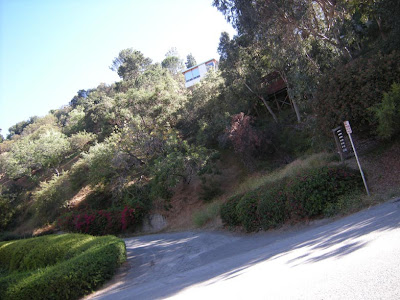
When the four Family members arrived at the entrance to the Cielo Drive property, Watson climbed a telephone pole near the gate and cut the phone line. He had been to the house previously, on Family matters.
It was now around midnight and into August 9, 1969. Backing their car down to the bottom of the hill that led up to the place, the group parked there and walked back up to the house. Thinking the gate might be electrified or rigged with an alarm, they climbed a brushy embankment at its right and dropped onto the grounds. Just then, headlights came their way from farther within the angled property. Telling the women to lie in the bushes, Watson stepped out, gave a command to halt, and shot to death the approaching driver, 18-year-old Steven Parent. After cutting the screen of an open window of the main house, Watson told Kasabian to keep watch down by the gate. He removed the screen, entered through the window, and let Atkins and Krenwinkel in through the front door.

Slaughter
As Watson whispered to Atkins, Polanski's friend Wojciech Frykowski awoke on the living-room couch; Watson kicked him in the head. When Frykowski asked him who he was and what he was doing there, Watson replied, "I’m the devil, and I’m here to do the devil’s business."
On Watson’s direction, Atkins found the house's three other occupants and, with Krenwinkel's help, brought them to the living room. The three were Tate, eight and a half months pregnant; her friend and former lover Jay Sebring, a noted hairstylist; and Frykowski’s lover Abigail Folger, heiress to the Folger coffee fortune. Polanski, Tate's husband, was in London, at work on a film project.
Watson began to tie Tate and Sebring together by their necks with rope he'd brought and slung up over a beam. Sebring's protest—his second—of rough treatment of Tate prompted Watson to shoot him. Folger was taken momentarily back to her bedroom for her purse, out of which she gave the intruders $70. After that, Watson stabbed the groaning Sebring seven times.
Frykowski's hands had been bound with a towel. Freeing himself, Frykowski began struggling with Atkins, who stabbed at his legs with the knife with which she had been guarding him. As he fought his way toward and out the front door, onto the porch, Watson joined in against him. Watson struck him over the head with the gun multiple times, stabbed him repeatedly, and shot him twice. Watson broke the gun's right grip in the process.
Around this time, Kasabian was drawn up from the driveway by "horrifying sounds." She arrived outside the door. In a vain effort to halt the massacre, she told Atkins falsely that someone was coming.
Inside the house, Folger had escaped from Krenwinkel and fled out a bedroom door to the pool area. Folger was pursued to the front lawn by Krenwinkel, who stabbed – and finally, tackled – her. She was dispatched by Watson; her two assailants had stabbed her twenty-eight times. As Frykowski struggled across the lawn, Watson finished him with a final flurry of stabbing. Frykowski was stabbed a total of fifty-one times.
Back in the house, Atkins, Watson, or both killed Tate, who was stabbed sixteen times. Tate pleaded to be allowed to live long enough to have her baby; she cried, "Mother... mother..." until she was dead.

Earlier, as the four Family members had headed out from Spahn Ranch, Manson had told the women to "leave a sign… something witchy." Using the towel that had bound Frykowski’s hands, Atkins wrote "pig" on the house’s front door, in Tate's blood. En route home, the killers changed out of bloody clothes, which were ditched in the hills, along with their weapons.
In initial confessions to cellmates of hers at Sybil Brand Institute, Atkins would say she killed Tate. In later statements to her attorney, to prosecutor Vincent Bugliosi, and before a grand jury, Atkins indicated Tate had been stabbed by Tex Watson. In his 1978 autobiography, Watson himself said that he stabbed Tate and that Atkins did not. Since he was aware that the prosecutor, Bugliosi, and the jury that had tried the other Tate-LaBianca defendants were convinced Atkins had stabbed Tate, he falsely testified that he did not stab her.
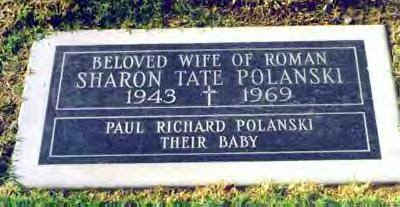
The funerals for the five victims were held on Wednesday, August 13. Sharon Tate was interred in the Holy Cross Cemetery, Culver City, California, with her son, Paul Richard Polanski (named posthumously for Polanski's and Tate's fathers), in her arms. The funerals of Tate and Sebring were separated by several hours to allow mourners to attend both.


A decade after the murders, Tate's mother, Doris, in response to the growing cult status of the killers and the possibility that any of them might be granted parole, organized a public campaign against what she considered shortcomings in the state's corrections system which led to amendments to the California criminal law in 1982, which allowed crime victims and their families to make victim impact statements during sentencing and at parole hearings. Doris Tate was the first person to make such an impact statement under the new law, when she spoke at the parole hearing of one of her daughter's killers, Charles "Tex" Watson. She later said that she believed the changes in the law had afforded her daughter dignity that had been denied her before, and that she had been able to "help transform Sharon's legacy from murder victim to a symbol of victims' rights."
Thursday, August 5, 2010
Deathday: Marilyn Monroe 1926-1962 Actress

Marilyn Monroe (June 1, 1926 – August 5, 1962), born Norma Jeane Mortenson, but baptized Norma Jeane Baker, was an American actress, singer and model.


After spending much of her childhood in foster homes, Monroe began a career as a model, which led to a film contract in 1946. Her early roles were minor, but her performances in The Asphalt Jungle and All About Eve (both 1950) were well received. She was praised for her comedic ability in such films as Gentlemen Prefer Blondes, How to Marry a Millionaire, Some Like It Hot and The Seven Year Itch, and became one of Hollywood's most popular and glamorous performers.

The typecasting of Monroe's "dumb blonde" persona limited her career prospects, so she broadened her range. She studied at the Actors Studio and formed Marilyn Monroe Productions. Her dramatic performance in William Inge's Bus Stop was hailed by critics, and she won a Golden Globe Award for her performance in Some Like it Hot.


The final years of Monroe's life were marked by illness, personal problems, and a reputation for being unreliable and difficult to work with. The circumstances of her death, from an overdose of barbiturates, have been the subject of conjecture. Though officially classified as a "probable suicide," the possibility of an accidental overdose, as well as the possibility of homicide, have not been ruled out.

In 1999, Monroe was ranked as the sixth greatest female star of all time by the American Film Institute.

On August 5, 1962, LAPD police sergeant Jack Clemmons received a call at 4:25 a.m. from Dr. Ralph Greenson, Monroe's psychiatrist, proclaiming that Monroe was found dead at her home in Brentwood, Los Angeles, California. She was 36 years old. At the subsequent autopsy, eight milligram percent of Chloral Hydrate and 4.5 milligram percent of Nembutal were found in her system, and Dr. Thomas Noguchi of the Los Angeles County Coroners office recorded cause of death as "acute barbiturate poisoning," resulting from a "probable suicide." Many theories, including murder, circulated about the circumstances of her death and the timeline after the body was found. Some conspiracy theories involved John and Robert Kennedy, while other theories suggested CIA or Mafia complicity.


On August 8, 1962, Monroe was interred in a crypt at Corridor of Memories #24, at the Westwood Village Memorial Park Cemetery in Westwood, Los Angeles. Lee Strasberg delivered the eulogy. The crypt space immediately to the left of Monroe's was bought and reserved by Hugh Hefner in 1992.

In August 2009, the crypt space directly above that of Monroe was placed for auction on eBay. Elsie Poncher plans to exhume her husband and move him to an adjacent plot. She advertised the crypt, hoping "to make enough money to pay off the $1.6 million mortgage" on her Beverly Hills mansion. The crypt's final sale price was $4.6 million.


Subscribe to:
Posts (Atom)