Lucrezia Borgia (18 April 1480 - 24 June 1519) was the daughter of Rodrigo Borgia, the powerful Renaissance Valencian who later became Pope Alexander VI, and Vannozza dei Cattanei. Her brothers included Cesare Borgia, Giovanni Borgia, and Gioffre Borgia.
Lucrezia's family later came to epitomize the ruthless Machiavellian politics and sexual corruption alleged to be characteristic of the Renaissance Papacy. Lucrezia was cast as a femme fatale, a role she has been portrayed as in many artworks, novels, and films.
One painting, Portrait of a Youth by Dosso Dossi at the National Gallery of Victoria, was identified as a portrait of Lucrezia in November 2008. This painting may be the only surviving formal portrait of Lucrezia Borgia. However, doubts have been cast on that claim. Several other paintings, such as Bartolomeo Veneziano's fanciful portrait, have also been said to depict her but none have been accepted by scholars at present. She is described as having heavy blonde hair which fell past her knees, a beautiful complexion, hazel eyes which constantly changed colour, a full, high bosom, and a natural grace which made her appear to "walk on air." These were the physical attributes that were highly appreciated in Italy during that period.
Very little is known of Lucrezia as a historical personage, and her complicity in the political machinations of her brothers and father cannot be determined at this time. Her father and/or brother certainly arranged several marriages for her to important or powerful men in order to advance their own political ambitions. Lucrezia was married to Giovanni Sforza (Lord of Pesaro), Alfonso of Aragon (Duke of Bisceglie), and Alfonso d'Este (Duke of Ferrara). Tradition has it that Alfonso of Aragon was an illegitimate son of the King of Naples and that Cesare may have had him murdered after his political value waned.
Lucrezia Borgia died in Ferrara on 24 June 1519 from complications after giving birth to her eighth child. She was buried in the convent of Corpus Domini.
On 15 October 1816, the Romantic poet Lord Byron visited the Ambrosian Library of Milan. He was delighted by the letters between Borgia and Bembo ("The prettiest love letters in the world") and claimed to have managed to steal a lock of her hair ("the prettiest and fairest imaginable") held on display.
Lucrezia is the ancestress of many notable people, including American Civil War general P.G.T. Beauregard and actress Brooke Shields. She is a collateral relative of most of the royal families of modern Europe including that of the United Kingdom.
Several rumours have persisted throughout the years, primarily speculating as to the nature of the extravagant parties thrown by the Borgia family. Many of these concern allegations of incest, poisoning, and murder on her part; however, no historical basis for these rumors has ever been brought forward, beyond allegations made by the rivals of the Borgias.
It is rumoured that Lucrezia was in possession of a hollow ring that she used frequently to poison drinks.
An early 20th-century painting by Frank Cadogan Cowper that hangs in the London art gallery, Tate Britain, portrays Lucrezia taking the place of her father, Alexander VI at an official Vatican meeting. This apparently documents an actual event, although the precise moment depicted (a Franciscan friar kissing Lucrezia's feet) was invented by the artist.
Director: F.W. Murnau
Originally released in 1922 as Nosferatu, Eine Symphonie Des Grauens, director F.W. Munarau's chilling and eerie adaption of Stoker's Dracula is a silent masterpiece of terror which to this day is the most striking and frightening portrayal of the legend.
Lizzie Andrew Borden (July 19, 1860 – June 1, 1927) was a New England spinster who was the central figure in the hatchet murders of her father and stepmother on August 4, 1892 in Fall River, Massachusetts in the United States. The murders, subsequent trial, and following trial by media became a cause célèbre. The fame of the incident has endured in American pop culture and criminology. Although Lizzie Borden was acquitted, no one else was ever arrested or tried, and she has remained notorious in American folklore. Dispute over the identity of the killer or killers continues to this day.
Despite incriminating circumstances, Lizzie Borden was acquitted on June 20, 1893 by a jury after an hour and a half's deliberation. The fact that no murder weapon was found and no blood evidence was noted just a few minutes after the second murder pointed to reasonable doubt. Her entire original inquest testimony was barred from the trial. Also excluded was testimony regarding her attempt to purchase prussic acid. Adding to the doubt was another axe murder in the area, perpetrated by José Correira, which took place shortly before the trial. While many details were similar, Correira was not in the country when the Borden murder took place. After the trial Borden and her sister moved to a new house called Maplecroft. In June 1905, the two argued over a party Lizzie gave for Nance O'Neil and a group of actors. Shortly after that, Emma moved out of the house, and Lizzie Borden began using the name "Lizbeth A. Borden."
Death
Lizzie Borden died of pneumonia on June 1, 1927 in Fall River, Massachusetts. Borden's funeral details were not made public and only a few people attended her burial. Borden was buried in Oak Grove Cemetery under the name "Lizbeth Andrew Borden," her footstone reading "Lizbeth." Never married, Borden's will, probated on June 25, 1927, left $30,000 to the Fall River Animal Rescue League. She also left $500 in perpetual trust for the care of her father's grave. Nine days later, her estranged sister, Emma Lenora Borden (below) died from a fall in Newmarket, New Hampshire, on June 10, 1927.
The house on Second Street where the murders occurred is now a bed and breakfast. Maplecroft, the mansion Borden bought after her acquittal, on then-fashionable French Street in the "highlands" is privately owned, and only occasionally available for touring.
Benjamin "Bugsy" Siegel (February 28, 1906 – June 20, 1947) was an American gangster who was involved with Italian-American organized crime. Siegel was a major driving force behind large-scale development of Las Vegas.
Early life
Benjamin Siegelbaum was born in Williamsburg, Brooklyn, to a poor Jewish family from Letychiv, Podolia Governorate of the Russian Empire, in modern Ukraine. As a boy, Siegel joined a gang on Lafayette Street on the Lower East Side of Manhattan and committed mainly thefts, until, with a youth named Moe Sedway, he devised his own protection racket: pushcart merchants were forced to pay him a dollar or he would incinerate their merchandise.
During adolescence, Siegel befriended Meyer Lansky, who was forming a small mob whose activities expanded to gambling and car theft. Siegel reputedly also worked as the mob's hit man, whom Lansky would hire out to other crime families. On January 28, 1929, Siegel married Esta Krakower, his childhood sweetheart and sister of hit man Whitey Krakower.

Las Vegas
Siegel yearned to be legitimate. The legitimacy and respectability he craved were beyond his reach. But by spring 1946, it became stronger - in William R. Wilkerson's Flamingo.
Las Vegas gave Siegel his second opportunity to reinvent himself. Siegel had traveled to Southern Nevada in 1934 with Meyer Lansky's lieutenant Moe Sedway, on Lansky's orders to explore expanding operations. Lansky had turned the desert over to Siegel. But Siegel, wanting nothing to do with it, turned it over to Moe Sedway and fled for Hollywood.
Lansky pressured Siegel to represent them in Wilkerson's desert project. Someone had to watchdog their interests. Siegel, who knew Wilkerson and lived near him in Beverly Hills, was the obvious choice as a liaison, but Siegel was infuriated. He wanted no part in any operation that took him back to Nevada permanently. It meant forsaking Beverly Hills and playboy life and enduring the heat of Nevada. At Lansky's insistence, however, Siegel consented.
Siegel accepts
Throughout the spring of 1946, Siegel proved useful. He obtained black market building materials. The postwar shortages that had dogged construction were no longer a problem. At first Siegel seemed content to do things Wilkerson's way. His desire to learn about the project took precedence over his sportsman lifestyle. It subdued his aggression. Under Wilkerson, Siegel played the pupil, learning the mechanics of building an enterprise. The role did not come easily. Perhaps outdistanced and afraid of being upstaged by his mentor, Siegel began to feel intimidated and paranoid. He grew resentful of Wilkerson's talent and vision. As time went on, the gangster's admiration disintegrated into insane jealousy. Siegel reverted to his familiar role; the big-shot. He began making decisions without Wilkerson's authority. Informing work crews that Wilkerson had put him in charge, Siegel ordered changes which conflicted with the blueprints.
The problem came to a head when Siegel demanded more involvement in the project. To keep the project moving, Wilkerson agreed that Siegel would supervise the hotel while Wilkerson retained control of everything else.
In May 1946, Siegel decided the agreement had to be altered to give him control of the Flamingo. Siegel offered to buy out Wilkerson's creative participation with corporate stock - an additional 5 percent ownership in the operation. On June 20, 1946, Siegel formed the Nevada Project Corporation of California, naming himself president. He was also the largest principal stockholder in the operation, which defined everyone else merely as shareholders. From this point the Flamingo became syndicate-run.
Las Vegas' beginning
Siegel began a spending spree, staggering even today. He demanded the finest building that money could buy at a time of wartime shortages. Each bathroom of the 93-room hotel had its own sewer system (cost: $1,150,000); more toilets were ordered than needed (cost: $50,000); because of the plumbing alterations, the boiler room, now too small, had to be enlarged (cost: $113,000); and Siegel ordered a larger kitchen (cost: $29,000). Adding to the budgetary over-runs were problems with dishonest contractors and disgruntled unpaid builders. By day, trucks delivered black market goods. By night the same materials were pilfered and resold to Siegel a few days later. As costs soared, Siegel's checks began bouncing. By October 1946, the costs had soared above $4 million. In spring 1947, the Flamingo would clock in at over $6 million.
The first indication of trouble came in early November 1946. The syndicate issued an ultimatum: provide accounting or forfeit funding. But producing a balance sheet was the last thing Siegel wanted to do. After the syndicate's refusal of help, Siegel waged a campaign of private fund raising. He sold nonexistent stock. Siegel was in a hurry to finish. He doubled his work force, believing the project could be completed in half the time. But it was costs, not building, that began rising faster. Siegel paid overtime and double-time. In some cases, bonuses tied to project deadlines were offered in hope of increasing productivity. By the end of November work was nearly finished.
Under pressure to have the hotel make some money, Siegel moved the opening from Wilkerson's original date of March 1, 1947 to the day after Christmas, 1946. Although the hotel was incomplete he was hoping to generate enough from the casino to complete the project and repay investors. Siegel announced the hotel would be ready the day after Christmas. Its opening would be held that same evening, December 26, 1946. Siegel generated confusion regarding the opening date. Acting on a whim, he decided a weekend would be more likely to entice celebrities away from home. Invitations were sent out for Saturday, December 28. Siegel changed his mind again. Invitees were notified by phone that the opening had been changed back to the 26th.
Devastation
While locals jammed the opening, few celebrities materialized. A handful did motor in from Los Angeles despite appalling weather. Some of the celebrities present were June Haver, Vivian Blaine, George Raft, Sonny Tufts, Brian Donlevy and Charles Coburn. They were welcomed by construction noise and a lobby draped with decorators' drop cloths. The desert's first air conditioning collapsed regularly. While gambling tables were operating, the luxury rooms that would have served as the lure for them to stay and gamble longer were not ready. After two weeks the Flamingo's gaming tables were $275,000 in the red and the entire operation shut down in late January 1947. By begging the mob bosses to give his friend a second chance, Lansky got an extension for Bugsy. After being granted a second chance, Bugsy cracked down and did everything possible to turn the Flamingo into a success. However, by the time profits began making a turn for the better the mob bosses above Bugsy were tired of waiting around.
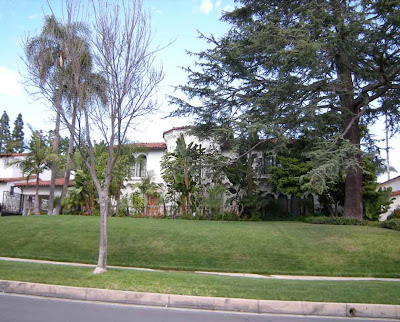 On the night of June 20, 1947, as Siegel sat with his associate Allen Smiley in Virginia Hill's Beverly Hills home reading the Los Angeles Times, an unknown assailant fired at him through the window with a .30-caliber military M1 carbine, hitting him many times, including twice in the head. No one was charged with the murder, and the crime remains officially unsolved.
 Though descriptions held that Siegel was shot in the eye, he was actually struck twice on the right side of his head. Both death scene and postmortem photographs clearly show that one shot penetrated his right cheek and exited through the left side of his neck; the other struck the right bridge of his nose where it met the right eye socket.
This second shot passed behind Siegel's left eye before exiting directly behind his left zygomatic bone where it meets the left temporal bone. Overpressure created by that bullet's striking and passing through Siegel's skull blew his left eye out of its socket. Both the Los Angeles' Coroner's Report (#37448) and his death certificte (Registrar's #816192) state the cause of death was cerebral hemorrhage.
 Though as noted, Siegel was actually not shot exactly through the eye (the eyeball would have been destroyed if this had been the case), the bullet-through-the-eye style of killing nevertheless became popular in Mafia lore and in movies, and was called the "Moe Greene special" after the character Moe Greene - based on Siegel - who was killed in this manner in The Godfather.
 Siegel was hit by many other bullets including shots through his lungs. According to Florabel Muir, "Four of the nine shots fired that night destroyed a white marble statue of Bacchus on a grand piano, and then lodged in the far wall."
 Benjamin Siegel's crypt is located in Beth Olam Mausoleum at the Hollywood Forever Cemetery, Hollywood.

Julius Rosenberg (May 12, 1918 – June 19, 1953) and Ethel Greenglass Rosenberg (September 28, 1915 – June 19, 1953) were American communists who were executed in 1953 for conspiracy to commit espionage. The charges related to passing information about the atomic bomb to the Soviet Union. This was the first execution of civilians for espionage in United States history.
Since the execution, decoded Soviet cables, codenamed VENONA, have supported courtroom testimony that Julius acted as a courier and recruiter for the Soviets, but doubts remain about the level of Ethel's involvement. The decision to execute the Rosenbergs was, and still is, controversial. The New York Times, in an editorial on the 50th anniversary of the execution (June 19, 2003) wrote, “The Rosenbergs case still haunts American history, reminding us of the injustice that can be done when a nation gets caught up in hysteria.” The other atomic spies that were caught by the FBI offered confessions and were not executed. Ethel's brother, David Greenglass, who supplied documents to Julius from Los Alamos, served 10 years of his 15 year sentence. Harry Gold, who identified Greenglass, served 15 years in Federal prison as the courier for him and the British scientist, Klaus Fuchs. Morton Sobell, who was tried with the Rosenbergs, served 17 years and 9 months. In 2008, Sobell admitted he was a spy and confirmed Julius Rosenberg was "in a conspiracy that delivered to the Soviets classified military and industrial information and what the American government described as the secret to the atomic bomb." He believed Ethel was aware of the espionage, but did not actively participate. In a letter to the New York Times soon after the Roberts article appeared, Sobell denied that he knew anything about Julius Rosenberg's alleged atomic espionage.


"I consider your crime worse than murder...I believe your conduct in putting into the hands of the Russians the A-Bomb years before our best scientists predicted Russia would perfect the bomb has already caused, in my opinion, the Communist aggression in Korea, with the resultant casualties exceeding 50,000 and who knows but that millions more of innocent people may pay the price of your treason. Indeed, by your betrayal you undoubtedly have altered the course of history to the disadvantage of our country. No one can say that we do not live in a constant state of tension. We have evidence of your treachery all around us every day for the civilian defense activities throughout the nation are aimed at preparing us for an atom bomb attack."
Nobel Prize winner Jean-Paul Sartre called the case "a legal lynching which smears with blood a whole nation. By killing the Rosenbergs, you have quite simply tried to halt the progress of science by human sacrifice. Magic, witch-hunts, auto-da-fés, sacrifices — we are here getting to the point: your country is sick with fear... you are afraid of the shadow of your own bomb."
Others, including non-Communists such as Albert Einstein and Nobel-Prize-winning physical chemist Harold Urey, as well as Communists or left-leaning artists such as Nelson Algren, Dashiell Hammett, Jean Cocteau, Diego Rivera and Frida Kahlo, protested the position of the American government in what the French termed America's Dreyfus Affair. In May 1951, Pablo Picasso wrote for French newspaper L’Humanité, "The hours count. The minutes count. Do not let this crime against humanity take place." Pope Pius XII also condemned the execution. The all-black International Longshoremen’s Association Local 968 stopped working for a day in protest. Cinema artists such as Fritz Lang and Bertolt Brecht registered their protest. Pope Pius XII appealed to President Dwight D. Eisenhower to spare the couple, but Eisenhower refused on February 11, 1953, and all other appeals were also unsuccessful.
Their case has been at the center of the controversy over Communism in the United States ever since, with supporters steadfastly maintaining that their conviction was an egregious example of political persecution (see McCarthyism) and likening it to the witch hunts that marred Salem and Early Modern Europe (a comparison that provided the inspiration for Arthur Miller's critically acclaimed play, The Crucible).
Execution
Because the United States Federal Bureau of Prisons did not operate an electric chair at the time, the Rosenbergs were transferred to the New York State-run Sing Sing Correctional Facility in Ossining for execution. The couple were executed at sundown in the electric chair on June 19, 1953. This was delayed from the originally scheduled date of June 18 because, on June 17, Supreme Court Associate Justice William O. Douglas had granted a stay of execution. That stay resulted from the intervention in the case of Fyke Farmer, a Tennessee lawyer whose efforts had previously met with scorn from the Rosenbergs' attorney.
On June 18, the Court was called back into special session to dispose of Douglas' stay rather than let the execution be delayed for months while the appeal that was the basis of the stay wended its way through the lower courts. The Court did not vacate Douglas' stay until noon on June 19. Thus, the execution then was scheduled for later in the evening after the start of the Jewish Sabbath. Desperately playing for more time, their lawyer, Emanuel Hirsch Bloch, filed a complaint that this offended their Jewish heritage, so the execution was scheduled before sunset, at 8 P.M. on Friday instead of the regular time of execution at Sing-Sing of 11 P.M. which usually took place on Thursday.
Eyewitness testimony (as given by a newsreel report featured in the 1982 documentary film The Atomic Cafe) describes the circumstances of the Rosenbergs' death, noting that while Julius Rosenberg died after the first series of electrocutions, his wife did not. After the normal course of electrocutions, attendants removed the strapping and other equipment only to have doctors determine that Mrs. Rosenberg had not yet died (her heart was still beating). Three courses of electrocution were ultimately applied, and at conclusion eyewitnesses reported, Bob Considine among them, a grisly scene with smoke rising from her head in the chamber.
Ethel and Julius Rosenberg were buried at Wellwood Cemetery in Pinelawn, New York.


